
How to Check Criminal History in Corning
Begin with the office that made the record. Corning Police holds reports created by city officers. Tehama County Jail holds booking and current-custody data. Tehama Superior Court keeps filed charges, hearings, and dispositions. California DOJ offers fingerprint-based review of a person's own statewide record, not a public name search for someone else. These sources should be checked separately because no single Corning system combines them.
- Review Corning Citizen RIMS for public police activity.
- Submit Corning's form when the actual police report is needed.
- Check the county jail source for current booking or custody.
- Ask Tehama Superior Court for filed cases and dispositions.
- Use California DOJ Live Scan to review only your own statewide record.
Corning Citizen RIMS Records
The city's Police Documents page links CPD Online, which redirects to Corning Citizen RIMS. The official portal can place an event within Corning Police activity, but it does not replace a complete incident report or a court file. Search the public categories first, then request the source document if the result is too brief.
The manifest capture shows the Corning portal's agency entry point.
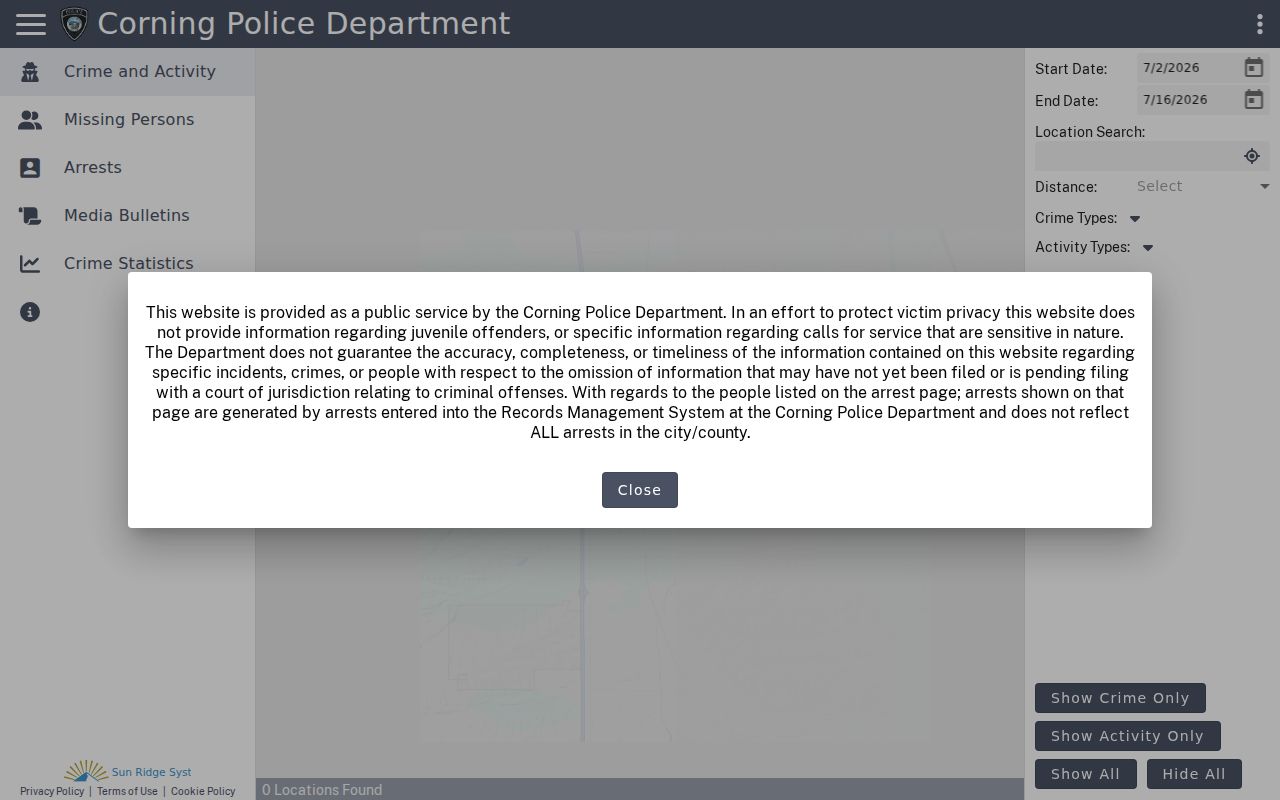
An arrest item should lead to separate jail and court checks because each system records a different stage.
The Corning Police Department
Corning Police Department is at 774 Third Street, Corning, CA 96021. It lists (530) 824-7000 as the non-emergency number, (530) 824-7010 as fax, and 24-hour status. The department is the source for reports created by Corning officers. Call 911 for emergencies.
The department must apply state law and policy before releasing a report. Give the incident date, location, report number, and involved name when known. Protected facts and active investigative material may be withheld or redacted.
The official police page identifies the local records source.
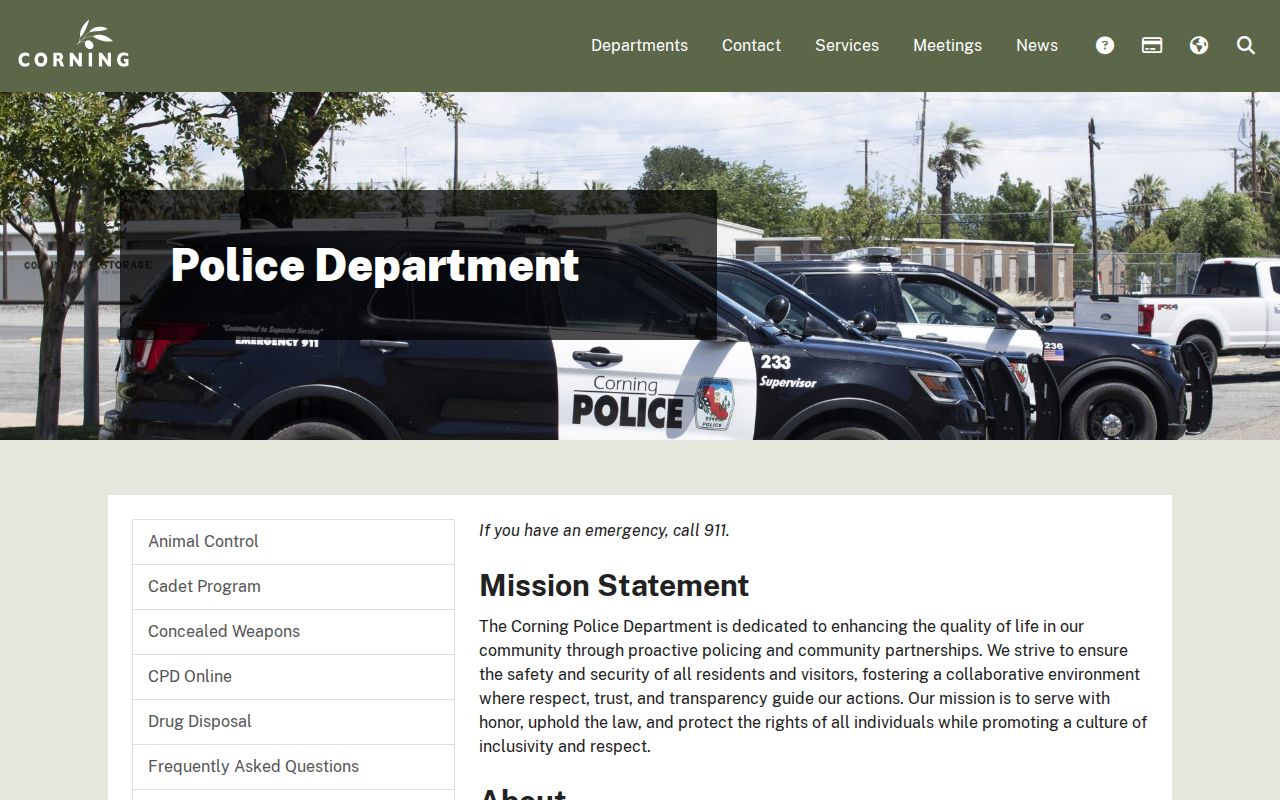
Use this channel for the police narrative, not the later court disposition.
Corning Police Report Copy Form
Corning provides a dedicated Request Copy of Police Report form. Submission starts a review; it does not guarantee that every page can be released. The official FAQ says the department will respond within 10 days.
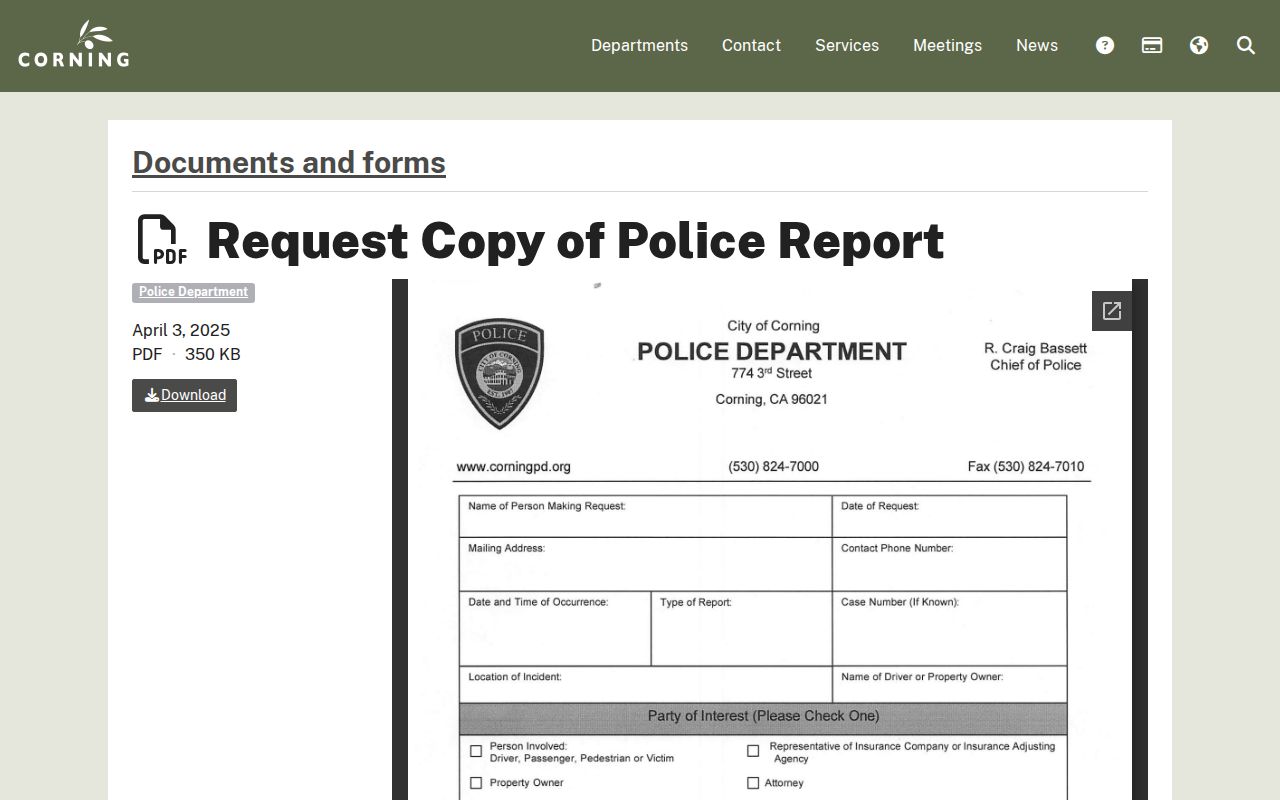
The form is the right path when Citizen RIMS does not supply the full source record.
Arrests and Bookings in Corning
Corning Police creates the arrest report, but a booked person enters the Tehama County Jail system. The sheriff's current-inmate listing may show booking date, charge text, bail, and release information. It is a current custody tool, not a complete archive and not proof of guilt.
After release, request the city report from Corning Police and older booking material from the Sheriff's Records Division. If charges were filed, the Superior Court record supplies the outcome. An arrest and a conviction are distinct events.
Corning Police Document Routes
The Corning Police Documents page lists the report-copy form, police complaint form, trespass admonishment, housewatch request, and military equipment policy. Each serves a different task. A complaint form is not a substitute for a records request.
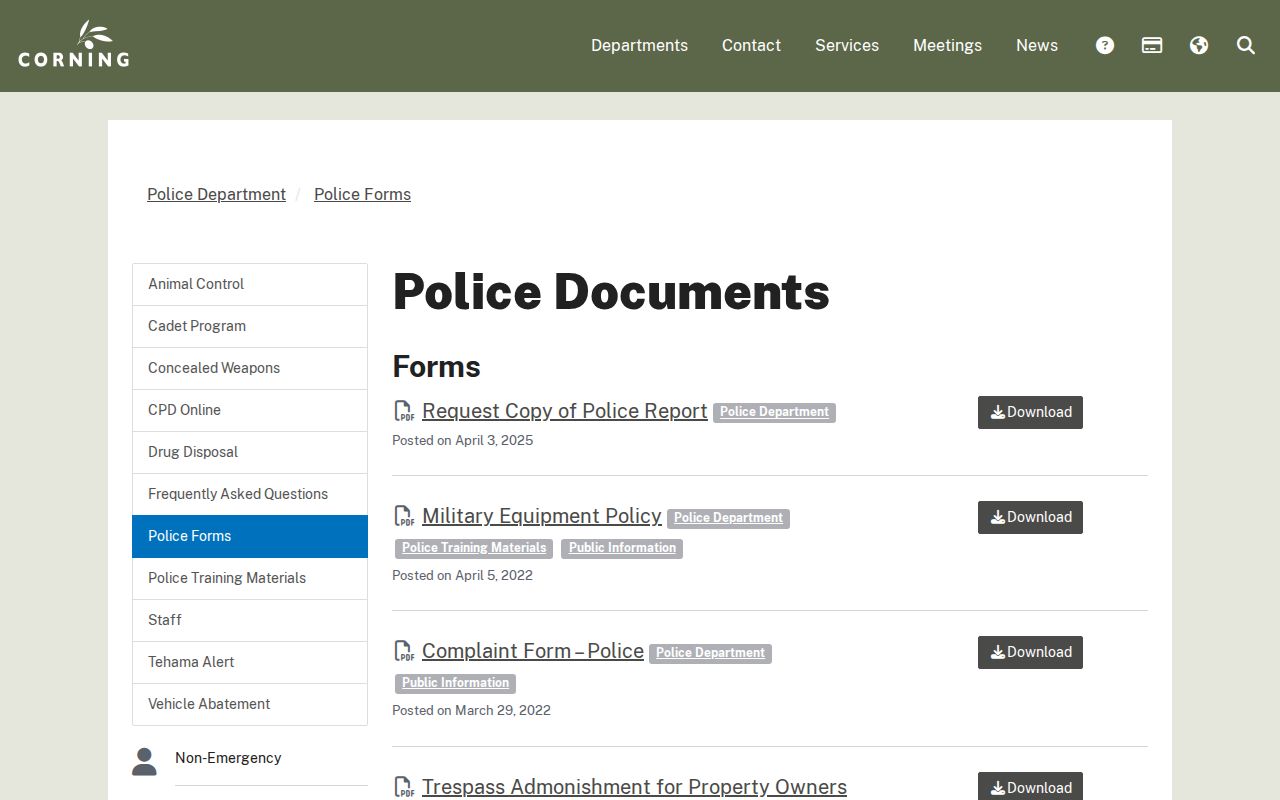
Selecting the right document helps Corning staff route the request without confusing a copy request with another police service.
Corning Municipal Court Records
No separate Corning municipal criminal court was found in the official sources reviewed. Tehama Superior Court's Criminal Division in Red Bluff hears felonies, misdemeanors, and infractions. The clerk maintains filed cases, events, dispositions, and copy files. Corning Police remains the holder of the original police report.
| Court Name | Superior Court of California, County of Tehama |
|---|---|
| Case Types Heard | Felonies, misdemeanors, and infractions |
| Case Lookup Channel | Tyler search, calendar portal, clerk counter, or mail |
| What the Docket Shows | Charges, events, hearings, and dispositions |
| Copies & Fees | $0.50 per page; certification adds $40 |
Corning Reports and Court Cases
Police and court records answer different questions. Corning Police documents the response, statements, and arrest. The Superior Court shows what prosecutors filed and what happened in court. Some arrests do not produce a filed case, and filed charges may differ from initial booking language.
Ask police for the report number and the clerk for the court case number. The broader Tehama County criminal court case resource explains the clerk route. Keeping the two identifiers separate reduces mistaken matches.
Where Corning Records End Up
A city event begins in Corning Police files. Booking creates a county jail record. Filed charges create a Superior Court case. Fingerprint and disposition reporting may feed the California DOJ repository, where the subject can use fingerprint review to see the statewide record.
Record flow: Corning Police › Tehama County Jail and Superior Court › California Department of Justice
Recent activity appears first with police or the jail. The court becomes central after filing. California provides no general public name-based rap-sheet portal.
Corning Agency Routing Matters
Corning operates its own police department, while the sheriff covers many county areas. CHP handles its own highway enforcement and crash records. The agency name on a citation, receipt, or report number should control the request. Corning Police cannot produce a sheriff or CHP report merely because an event happened near Corning.
This agency split is especially important along the south county travel corridor. Confirm jurisdiction first. Then use the producing agency's records channel, the county jail for custody, and the court for filed charges.
Corning Arrest With No Case
A recent Corning arrest may appear in police or jail data before any court case can be found. That delay can reflect ordinary processing. Officers prepare reports, the jail records a booking, prosecutors review the material, and only a filed complaint creates a Superior Court case. Searchers should not treat an empty court result as proof that the arrest record is wrong.
First confirm the spelling and incident date with Corning Police. Then check whether the person remains in county custody. If enough time has passed, ask the Superior Court clerk about a filed case in person or by written request because court staff does not perform criminal-record searches by telephone. The Tyler portal may help, but its own warning excludes active-warrant, collections, and contested matters. If prosecutors decline to file, the police and booking records can still exist without a criminal disposition.
Reading Corning Record Fields
Terms change as a matter moves through Corning's record chain. An incident number identifies the police report. A booking number belongs to the jail event. A case number identifies the court file. Charge text may also change. The arresting officer records suspected offenses, while prosecutors decide what to file and the court records the final disposition.
Match a person with more than a name. Use the event date, agency, location, case or report number, and other lawful identifiers available in the source. This matters when records contain similar names or aliases. A current-inmate entry can be sparse, and the court calendar warns that online material may lag. The source document is stronger than a summary screen, while a certified court copy is the proper choice when certification is actually required.
Corning Copies and Response Timing
The Corning Police FAQ gives a 10-day response period for report-copy requests. That is distinct from the county public-record form, which says a department may require up to 10 days to copy requested records and lists copies at 10 cents per page. The Superior Court uses a different schedule: ordinary copies cost 50 cents per page and certification adds $40.
Do not assume one agency's fee or timing controls another. Ask Corning Police about its current report-copy charge because the official page reviewed did not publish a specific amount. For court copies, include the case name, case number, document names, contact information, and payment arrangement requested by the clerk. Accurate details save time and help the custodian find the intended Corning record without opening an overly broad search.
Corning Record Request Checklist
A useful Corning request begins with facts, not conclusions. State the date or date range, location, responding agency, involved name, and known report or case number. Say whether inspection, an ordinary copy, or a certified court copy is needed. Give current contact information so staff can clarify the scope or explain a lawful withholding. For a police report, use Corning's form and send it to the police department. For a court document, write to or visit the Superior Court clerk because staff will not perform a criminal-record search by telephone.
Keep the agency response with the request. A denial or redaction may identify the legal reason and help narrow a follow-up. If no record is found, recheck the agency and identifier before assuming the event was never recorded. A Corning incident can sit with city police, the sheriff, CHP, the jail, or the court depending on the stage and jurisdiction.
Public Access Rules for Corning Records
The California Public Records Act supports inspection and copying of agency records, subject to exemptions. Active investigations, protected personal details, juvenile material, victim information, and sealed records may be withheld or redacted. Court files follow separate court-access rules. A focused request should identify the record and the office that holds it.
Key Statutes:
California Public Records Act provides access to agency records subject to statutory exemptions.
Penal Code section 11105 limits dissemination of California summary criminal history.
California Rule of Court 2.503 governs remote electronic access to court records.